Reinventing Route Optimization for a Modern World
How can we address the evolving challenges in global logistics with modern technology?
For years, traditional methods like Dijkstra’s algorithm have formed the foundation of route planning. However, in the current dynamics of supply chains, these methods fall short. Their slowness and inflexibility have become a bottleneck in an environment where real-time adjustments for factors such as traffic congestion or last-minute delivery changes are essential.
There is now a groundbreaking solution: an algorithm that harnesses the power of existing technology to make route calculations both faster and smarter. We call this innovation VSPA (Vectorized Shortest Path Algorithm). Developed by ORTEC’s optimization team, it significantly cuts processing time and makes it possible to seamlessly integrate complex variables, such as vehicle restrictions and environmental zones. The result is dynamic, real-time planning that elevates the efficiency and flexibility of logistics operations to a new level.
In a world where speed and efficiency make all the difference in logistics, the ability to instantly calculate the optimal route is invaluable. Bas den Heijer, who has been one of the driving forces behind ORTEC’s mapping and routing solutions for over a decade, knows this better than anyone. He combines analytical precision with an unrelenting drive to solve complex problems.
“Route planning is the backbone of modern logistics,” Den Heijer says, “but the tools we used for years could no longer keep up with the growing demand.” In 2022, a bold idea led to a breakthrough that not only transformed ORTEC’s technology but also has the potential to reshape the entire sector.
The Limitations of Using Traditional Route Algorithms
Why do today’s complex transportation networks struggle with conventional route calculation methods?
For years, Edsger Dijkstra’s algorithm, published in 1959, formed the basis of route planning. A classic in computer science, the algorithm calculates the shortest path between two points based on factors like distance or time. Of course, the algorithm has been improved upon in the decades that followed, for example by Customizable Route Planning and Contraction Hierarchies. But at their core, these improvements still use a Dijkstra-style loop. And in today’s world, that no longer suffices.
“Although Dijkstra’s algorithm is brilliant, it wasn’t designed for the scale and speed we now require,” Den Heijer explains. “In a world where millions of packages are delivered daily, the step-by-step approach slows down operations. The innovation of our approach is that we don’t need the Dijkstra loop any more.”
The issue lies in the sequential nature of the algorithm. It explores a network step by step, each time choosing the best next option from a priority queue. This process, while reliable, is too slow for large-scale, real-time applications that also have to deal with modern-day dynamic variables, such as traffic congestion or specific vehicle restrictions.
Although Dijkstra’s algorithm is brilliant, it wasn’t designed for the scale and speed we now require. We needed something faster that could also handle the complexity of modern logistics.
One Bold Idea That Led to Revolutionary Results
How can we significantly improve both speed and accuracy of route optimization with innovative algorithms?
With this challenge in mind, Den Heijer and his team began searching for alternatives. They turned their attention to graphics processing units (GPUs), hardware that is capable of performing thousands of tasks simultaneously. GPUs were originally developed for video games, but now play a key role in AI. The idea of using them for route calculations was far from conventional. “It was a gamble,” Den Heijer admits. “Most route planning algorithms are inherently sequential, whereas GPUs excel in parallel processing. We had to rethink the entire approach.”
The breakthrough came when the team found a way to predefine the order of calculations, allowing the computer to process everything simultaneously. “That was the moment we thought: this could actually work,” Den Heijer recalls. It required creativity and a solid dose of technical ingenuity, but the team quickly saw the potential of this new direction, and realized it could work even without using GPUs.
The Breakthrough Moment
In December 2022, Den Heijer and two colleagues decided to put their idea to the test. They retreated for a week into a quiet corner of the ORTEC office, determined to build a prototype. “It was intense,” says Den Heijer. “We shut ourselves off from everything and everyone. By day three, we had a rough version running, and by day five, we were testing it with real routes. When we saw the first results, we could hardly believe it. It was one of those moments when you realize you’ve discovered something revolutionary.”
Even though the prototype ran on a traditional CPU, the results exceeded all expectations. The new algorithm delivered the same accuracy as traditional methods, but was ten times faster.
The trick was to predefine the calculation order, so the CPU could fully utilize its parallel power. Although the first version required a lot of memory and preparation time, the team quickly overcame these obstacles, making the algorithm suitable for practical use. As a result, VSPA was born.
It was one of those moments when you realize you’ve discovered something revolutionary.
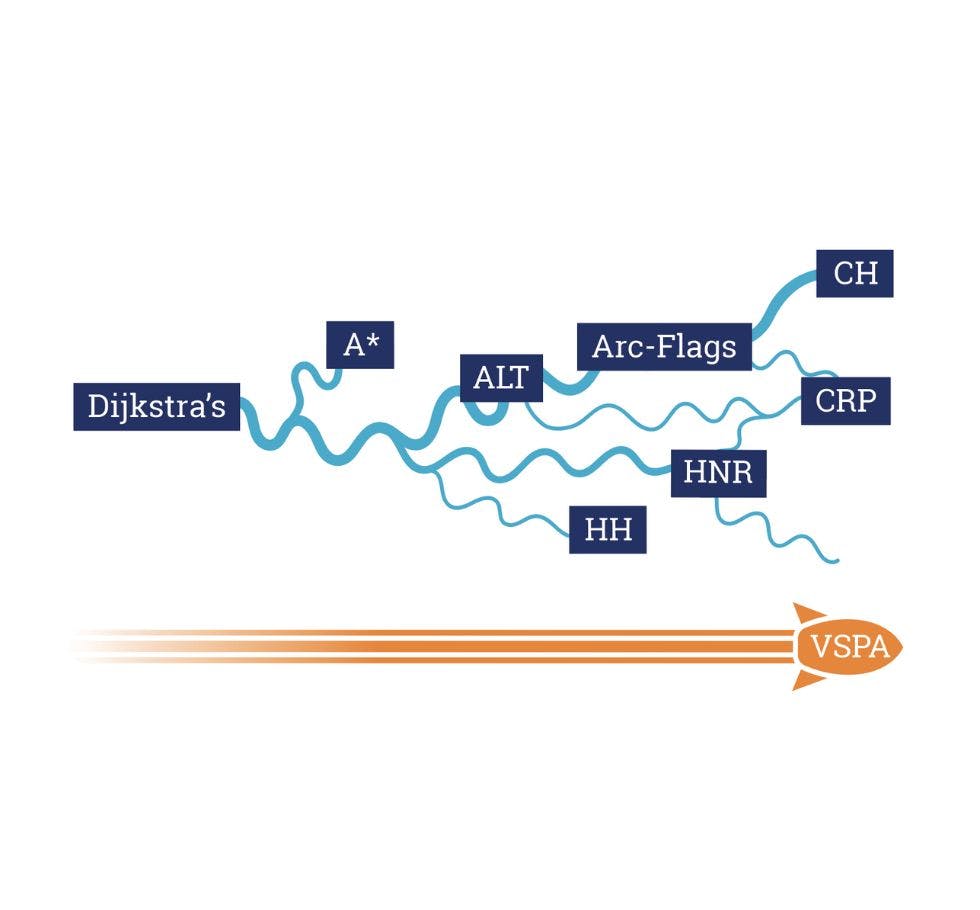
Benefits and Impact of ORTEC's Vectorized Shortest Path Algorithm (VSPA)
What does VSPA bring to route optimization in measurable efficiency gains and cost savings?
The benefits of the new algorithm are impressive. The new style of calculations has enormous benefits even for the traditional CPUs it’s currently running on. It significantly speeds up route calculations, which is crucial in a sector where every (milli)second counts. “Faster calculations mean a better experience for users and more efficient operations for our customers,” Den Heijer explains.
The new algorithm, unbound by the constraints of sequential processing, is also adaptable to the parallel capabilities of GPU. The team is now working on a GPU prototype that promises to be even faster, perhaps by as much as ten times compared to the current system.
But the impact goes beyond speed. Thanks to the extra computational capacity, more complex models can be used. “We can now start to incorporate real-time traffic data, vehicle-specific restrictions, and even environmental factors such as emission zones,” says Den Heijer. “We can incorporate that level of detail without the need for more computer power.”
Since early 2025, VSPA has been integrated into several ORTEC solutions, such as routing software, field service planning solutions, and cloud-based delivery systems. The positive reception and interest from external parties underscore the potential for broader applications.
Dive deeper — Download our ORTEC VSPA brochure.
Looking Ahead for Further Possibilities
What role will next-generation route optimization algorithms play across multiple industries?
As ORTEC continues to roll out this innovation, the team is already looking ahead. “This is just the beginning,” says Den Heijer. “There’s interest from logistics platforms, technology companies, and even car manufacturers who recognize the value of faster and more efficient route planning.” Beyond logistics, the algorithm could also be applicable in other areas with hierarchical networks, such as telecommunications or manufacturing.
For Den Heijer, however, the real reward is the opportunity to make a difference. “It’s not just about speed,” he reflects. “It’s about enabling smarter, more sustainable logistics that can adapt to the complexity of the modern world.” What began as an experiment in a quiet office corner has evolved into an innovation that is shaping the future of route planning.
Want to explore this breakthrough technology? Let ORTEC help you set a new standard.
Get Inspired! See how ORTEC's transformative supply chain solutions will elevate your logistics planning and operations.
About Bas den Heijer - Director of Engineering at ORTEC
Bas den Heijer has been working at ORTEC for over twelve years and leads the maps and routing team, internally known as the Atlas team. He has an academic background in computer science and mathematics and studied at Utrecht University. Outside of work, he has a passion for pub quizzes and computer games. As Director of Engineering, Den Heijer is responsible for the continued development of algorithms that quickly and accurately calculate routes in large-scale logistics networks. This work is essential to the performance of ORTEC solutions deployed in sectors such as transport, distribution, field service, and workforce planning.
It’s about enabling smarter, more sustainable logistics that can adapt to the complexity of the modern world.